Aerial Tree Surveys in Devon: Why Some Trees Need Closer Inspection
At DTG Trees & Grounds, every tree survey starts from the ground — but sometimes, ground-level inspections don’t tell the whole story.
During a recent site visit in South Devon, our PTI-qualified surveyor, Joe Cox, identified that a particular tree required a more detailed assessment from within the canopy. While ground-based surveys are suitable in many situations, certain defects simply can’t be accurately assessed from below.
That’s where aerial tree surveys come in.
What Is an Aerial Tree Survey?
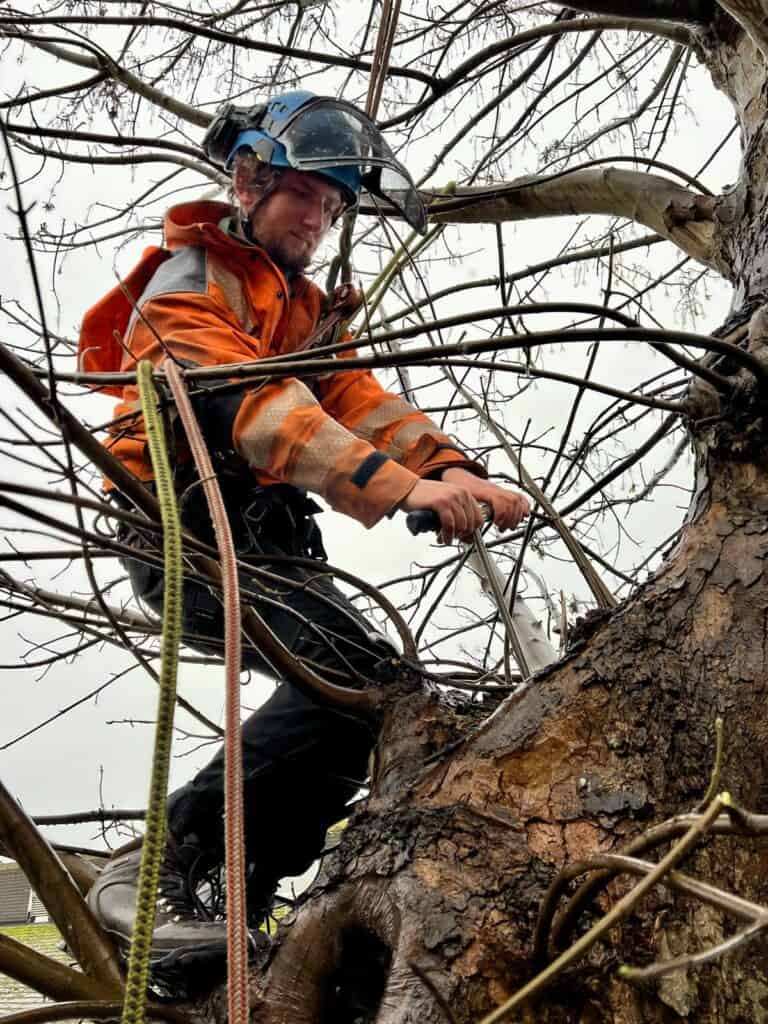
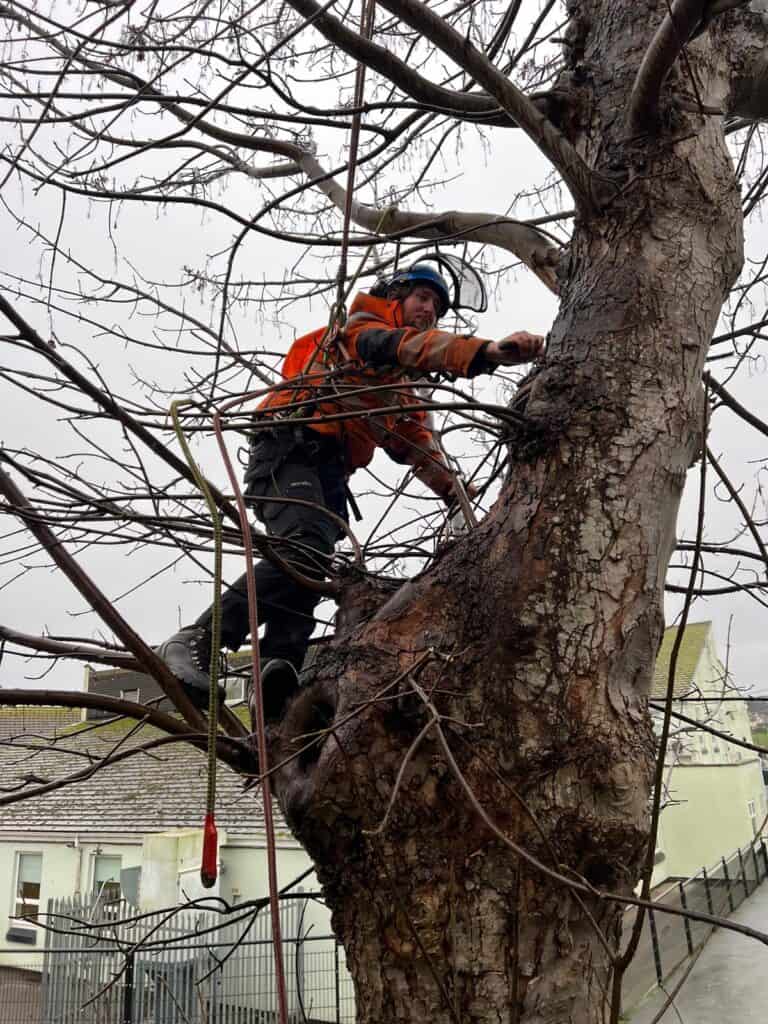
An aerial tree survey involves a qualified arborist accessing the tree using ropes and climbing equipment to inspect key structural areas at close range. This method allows us to examine unions, cavities, decay, and other potential weaknesses that may not be visible — or fully assessable — from the ground.
For trees in sensitive locations, high-risk environments, or with visible indicators of internal defects, aerial inspections are often the safest and most accurate way to get the full picture.
Why Ground-Based Inspections Aren’t Always Enough
Trees are complex living structures. While symptoms such as fungal growth, cracking, or movement can often be seen at ground level, their severity and true impact on structural integrity may be hidden inside the canopy or within unions.
From the ground, it can be difficult to accurately assess:
- The extent of decay within unions
- Cavities hidden by bark or canopy growth
- Compression forks and weak junctions
- Old pruning wounds higher in the crown
- Internal defects masked by healthy external growth
An aerial inspection allows us to investigate these areas directly, removing uncertainty and guesswork.
The Benefits of Aerial Tree Surveys
By carrying out an aerial tree inspection, we’re able to:
- Inspect unions, cavities, and decay at close range
- Accurately assess the tree’s structural integrity
- Identify hidden defects not visible from ground level
- Reduce unnecessary tree removals
- Provide clearer, evidence-based recommendations
This approach often leads to better outcomes for both safety and tree retention, particularly on sites where mature trees play an important visual or environmental role.

Combining Aerial Surveys with QTRA
At DTG Trees & Grounds, aerial inspections are often combined with QTRA (Quantified Tree Risk Assessment).
QTRA allows us to move beyond vague descriptions of risk and instead provide a clear, numerical assessment of:
- The likelihood of failure
- The size of the potential failure
- The level of risk to people or property
This gives clients a transparent understanding of not just what the issue is, but how significant it actually is.
The result?
✔ Better decision-making
✔ Improved site safety
✔ Cost savings by avoiding unnecessary work
Who Needs an Aerial Tree Survey?
Aerial tree surveys are particularly valuable for those responsible for trees on:
- Commercial sites
- Estates and large private properties
- Schools and educational grounds
- Public access areas
- Development or planning-sensitive sites
If you’re responsible for tree safety and need genuine peace of mind, this level of detail makes all the difference.
Professional Tree Surveys Across South Devon
Our team carries out professional tree surveys throughout South Devon, delivering accurate, defensible assessments backed by qualifications, experience, and best practice arboriculture.
If you need a detailed tree inspection, aerial survey, or risk assessment carried out properly — not rushed or guessed — we’re here to help.

Do you need help from our experts?
Give us a call today to get expert advice and support from our experienced team.