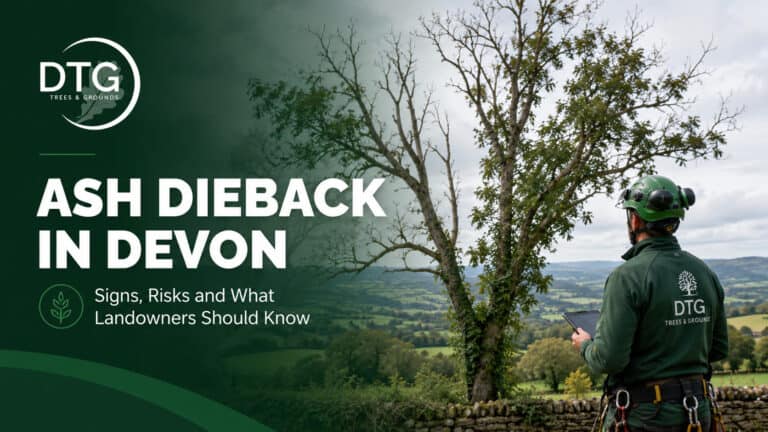
Ash Dieback in Devon: Signs, Risks and What Landowners Should Know
Ash trees are a familiar part of the Devon landscape. You see them along lanes, field boundaries, woodland edges, estates, gardens and public rights of way. They are a hugely important native tree, but over recent years many have been affected by ash dieback.
For landowners, estate managers, farmers, schools, commercial sites and homeowners with mature ash trees, it is worth understanding what ash dieback looks like, what risks it can create and when professional advice is needed.
At DTG Trees & Grounds, we regularly inspect and manage trees across Devon, including ash trees showing signs of decline. The important thing to remember is that not every affected ash tree needs to be removed straight away, but ignoring the problem can lead to much bigger safety concerns later on.
What Is Ash Dieback?
Ash dieback is a serious fungal disease affecting ash trees. It causes parts of the tree to decline over time, often starting with the leaves and smaller branches before spreading into the crown and main structure of the tree.
Some trees decline slowly over several years. Others deteriorate much more quickly, especially if they are already under stress from poor ground conditions, previous damage, drought or other disease.
Once ash dieback becomes advanced, the tree can become brittle and unpredictable. This makes it more difficult and more dangerous to work on, particularly where climbing would normally be required.
Common Signs of Ash Dieback
Ash dieback can show itself in different ways depending on the time of year and the stage of infection.
Some of the most common signs include:
- Sparse or thinning crowns
- Dead branches in the upper canopy
- Blackened or wilted leaves in summer
- Shoots dying back from the tips
- Dark lesions on stems or branches
- Cracks or staining around the base of the tree
- Epicormic growth, where new shoots appear lower down the trunk
- Large amounts of deadwood developing over time
During summer, ash dieback can often be easier to spot because the crown may look thin compared with nearby healthy trees. In winter, the lack of leaves makes it harder to judge crown health, although deadwood and structural defects may still be visible.
If you are unsure, it is always better to get the tree inspected rather than guessing from the ground.
Why Ash Dieback Matters for Landowners
For landowners, ash dieback is not just a tree health issue. It can become a safety and liability issue too.
Ash trees are often found in places where failure could cause harm, including:
- Roads and country lanes
- Driveways and access tracks
- Footpaths and public rights of way
- Field boundaries
- School grounds
- Car parks
- Gardens and neighbouring properties
- Commercial and estate land
A declining ash tree near a target, such as a road, building, vehicle route or public area, should be taken seriously. The risk is not only that the whole tree could fail, but that large branches may drop without much warning.
The earlier a tree is assessed, the more options there usually are. Waiting until the tree is severely decayed can make the work more complex, more expensive and more dangerous.
Does Every Ash Tree with Dieback Need Removing?
No. This is an important point.
Not every ash tree showing signs of dieback needs to be felled immediately. Some trees retain enough vitality to be monitored or managed, especially if they are away from people, buildings or access routes.
The decision depends on several factors, including:
- The level of dieback in the crown
- The tree’s location
- The likelihood of people or property being affected
- The tree’s structural condition
- Access for machinery or safe dismantling
- Whether the tree has other defects or decay present
In low-risk areas, a tree may be left standing for habitat value, particularly if it is away from regular public access. In higher-risk locations, action may be needed sooner.
A professional tree survey can help determine whether a tree should be monitored, reduced, made safe or removed.
Why Dangerous Ash Trees Need Specialist Handling
Ash affected by dieback can become brittle. This changes how tree work needs to be approached.
A tree that might once have been climbed safely may no longer be suitable for climbing if the structure has become too compromised. In those situations, specialist machinery, MEWPs or controlled dismantling methods may be required.
This is why it is important to use an experienced contractor. Ash dieback work is not just normal tree removal. The condition of the timber, the surrounding targets and the safest access method all need to be considered before work begins.
At DTG Trees & Grounds, we assess the site carefully before carrying out any tree surgery, especially where diseased or structurally weakened trees are involved.
Ash Trees Near Roads, Footpaths and Public Areas
Ash trees near public access areas should be prioritised for inspection.
For landowners, this is where duty of care becomes especially important. If a tree is visibly declining and located next to a road, footpath or regularly used area, it should not be left unchecked.
This does not always mean urgent removal, but it does mean the tree should be assessed and the findings recorded. Having a clear inspection record and professional recommendations can help show that reasonable steps have been taken.
Sites that may benefit from regular ash dieback inspections include farms, estates, schools, campsites, caravan parks, commercial premises and residential developments.
When Is the Best Time to Inspect Ash Dieback?
Ash dieback can be inspected at different times of year, but summer is often the best time to assess the level of crown decline because the tree should be in full leaf.
That said, if a tree already looks unsafe, has dropped branches or is close to a road, building or public area, it should not wait until summer. Safety concerns should be assessed as soon as they are noticed.
A practical approach is to inspect higher-risk ash trees regularly, then plan any required work before they deteriorate further.
Can Ash Dieback Spread to Other Trees?
Ash dieback primarily affects ash trees. It does not infect every tree species in the same way, but it can have a major impact where ash trees make up a large part of a hedge line, woodland edge or estate landscape.
For some landowners, managing ash dieback may involve more than removing individual trees. It may include planning replacement planting, improving woodland resilience or managing access routes where multiple ash trees are affected.
Thinking ahead can help reduce disruption and avoid dealing with large numbers of dangerous trees at once.
What Should You Do If You Suspect Ash Dieback?
If you think an ash tree on your land may be affected, start by looking at its location and the level of risk around it.
Ask yourself:
- Is it near a road, footpath, building or access route?
- Are large branches dying back?
- Has the tree dropped limbs recently?
- Does the crown look thin or uneven?
- Are there visible cracks, cavities or decay?
- Would failure put people, vehicles or property at risk?
If the answer to any of these is yes, it is sensible to arrange a professional inspection.
Avoid cutting or climbing the tree yourself. Diseased ash can be unpredictable, and poor decisions can make the situation more dangerous.
Professional Ash Dieback Advice Across Devon
DTG Trees & Grounds provides tree inspections, tree surgery and vegetation management across Devon for homeowners, landowners, estates, schools, commercial sites and local organisations.
If you have ash trees on your land and are concerned about their condition, we can assess the risk, explain your options and recommend the safest way forward.
In some cases, monitoring may be enough. In others, remedial work or removal may be the responsible choice. Either way, getting proper advice early gives you more control and helps keep people, property and outdoor spaces safe.
Do you need help from our experts?
Give us a call today to get expert advice and support from our experienced team.